DTF Transfers vs Sublimation Transfers
DTF Transfers vs Sublimation Transfers: Understanding the Key Differences
When businesses start exploring new garment decoration options, one of the most common questions is how DTF Transfers vs Sublimation Transfers compare, and which option makes the most commercial sense.
Both technologies produce high-quality, full-colour results. However, they serve different purposes. As a result, the right choice depends on the garments you want to decorate, the customers you serve, and how flexible you need your production to be.
At The Magic Transfer Company, we work with businesses of all sizes, from start-ups to established print shops. While sublimation still plays an important role in specific markets, DTF has rapidly grown because it offers far more flexibility across a wider range of fabrics and applications.
Understanding the differences helps you choose a solution that supports both your workflow and your long-term growth.
What Are DTF Transfers?
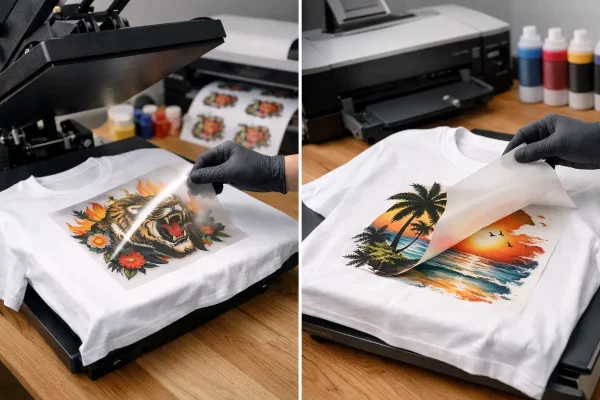
DTF (Direct to Film) transfers involve printing a design onto a specialist film using pigment inks. Next, you apply adhesive powder, cure the design, and finally heat press it onto the garment.
Because the design bonds to the surface of the fabric, DTF works across a wide range of materials, including:
- Cotton garments
- Polyester clothing
- Poly-cotton blends
- Hoodies and sweatshirts
- Workwear and uniforms
- Sportswear
- Tote bags
- Fashion apparel
This versatility is one of the main reasons businesses increasingly choose DTF when they want a single solution for multiple garment types.
What Are Sublimation Transfers?
Sublimation transfers use specialist inks printed onto sublimation paper. When heat and pressure are applied, the ink turns into a gas and permanently bonds with polyester fibres or polymer-coated surfaces.
Instead of sitting on top of the garment, the ink becomes part of the material itself.
Sublimation is commonly used for:
- Polyester sportswear
- Lightweight performance clothing
- Mugs and promotional gifts
- Coasters and hard surfaces
- Aluminium panels
- Phone cases
When used on the correct substrates, sublimation produces bright, long-lasting results with a very soft finish.
Contact us today for further details, samples or to arrange a demonstration
sales@themagictouch.co.uk or call 01582 671444
DTF Transfers vs Sublimation Transfers: Material Compatibility
This is the most important difference between the two systems.
DTF Transfers vs Sublimation Transfers often comes down to one key factor: what you want to print onto.
DTF offers excellent flexibility. You can apply it to cotton, polyester, blends, and even darker garments without changing your workflow. As a result, it suits businesses that deal with varied customer requests.
However, sublimation is much more selective. It works best on white or light-coloured polyester or specially coated surfaces. Because of this limitation, it becomes less suitable for cotton garments or dark textiles.
Therefore, if your customers regularly request mixed garment types, DTF provides a much wider commercial opportunity.
Print Feel and Finish
Both technologies deliver strong visual results, but the finish feels different.
Sublimation produces a completely smooth finish because the ink becomes part of the fabric. This creates a lightweight, breathable feel, which works especially well for sportswear and polyester garments.
DTF transfers sit on top of the garment as a flexible layer. Although modern DTF produces a soft and durable finish, the feel remains slightly different compared to sublimation.
However, in most commercial environments, customers prioritise durability, colour strength, and garment choice over subtle differences in texture.
Colour Performance and Design Flexibility
DTF Transfers vs Sublimation Transfers also differ significantly in how they handle colour and garment selection.
DTF uses a white ink base, which allows full-colour designs to appear clearly on both light and dark garments. This makes it ideal for:
- Black hoodies
- Navy workwear
- Coloured T-shirts
- Branded uniforms
- Retail clothing
Sublimation does not include a white ink layer. Instead, it relies on the colour of the fabric itself. Therefore, it performs best on white or very light polyester garments.
As a result, DTF provides far greater flexibility for businesses handling a wide range of orders.
Detail, Quality and Design Capability
Both methods produce excellent detail when set up correctly.
DTF is particularly strong when dealing with:
- Small text
- Fine line artwork
- Multi-colour logos
- Photographic designs
- Complex branding
Because of this, it has quickly become a preferred choice for commercial garment decorators.
Sublimation also produces outstanding image quality, especially on white polyester, where colours appear bright and vivid. However, its application range is more limited.
Contact us today for further details, samples or to arrange a demonstration
sales@themagictouch.co.uk or call 01582 671444
Workflow and Production Process
Understanding the workflow helps businesses decide which system fits their operation.
DTF involves several stages:
- Print onto film
- Apply adhesive powder
- Cure the design
- Heat press onto garment
Although this process includes more steps, it gives you significantly more flexibility across different garment types.
Sublimation follows a simpler workflow:
- Print onto transfer paper
- Position the design
- Apply heat and pressure
- Remove paper
Because of its simplicity, sublimation suits businesses focused on consistent polyester or promotional product production.
However, DTF offers a broader return because it supports a wider customer base.
Business Flexibility and Growth Potential
When comparing DTF Transfers vs Sublimation Transfers, flexibility often becomes the deciding factor.
DTF allows you to respond to varied customer demand without changing your production method. Whether the order is cotton T-shirts, hoodies, or mixed garment runs, you can usually complete the job using the same system.
Sublimation, however, works best within a narrower product range. If your business specialises in polyester sportswear or promotional gifts, it performs very well. But it offers less flexibility when customers request mixed materials.
Therefore, many businesses choose DTF when they want to expand their service offering.
Equipment, Training and Support
Whichever system you choose, success depends on more than just the printer.
Reliable production requires:
- Correct consumables
- Proper training
- Technical support
- Installation guidance
- Maintenance advice
- Workflow optimisation
At The Magic Transfer Company, we focus on complete production solutions rather than standalone equipment. This ensures businesses can produce consistent, profitable output with fewer production issues and less downtime.
Can You Use Both Systems Together?
Yes, and many businesses do.
In fact, DTF Transfers vs Sublimation Transfers is not always an either-or decision.
Sublimation works well for:
- Polyester sportswear
- Coated promotional products
- Hard surface printing
DTF complements this by covering:
- Cotton garments
- Dark clothing
- Mixed fabric orders
- Fashion and retail apparel
Together, they allow businesses to serve a much broader market.
Final Thoughts
Both DTF and sublimation have clear strengths, and both remain valuable technologies within the print industry.
Sublimation excels in polyester and coated product applications, delivering a soft and vibrant finish. Meanwhile, DTF has become the more flexible and commercially adaptable option for businesses handling varied garment types.
Ultimately, the right choice depends on your customer base and your production goals. However, for many businesses looking for growth and versatility, DTF offers the broader opportunity.
When comparing DTF Transfers vs Sublimation Transfers, the key is not just print quality, but how well the technology supports your business in real-world production.
If you are considering expanding into DTF, our team can help you choose the right setup, consumables and support package to ensure consistent results from day one.